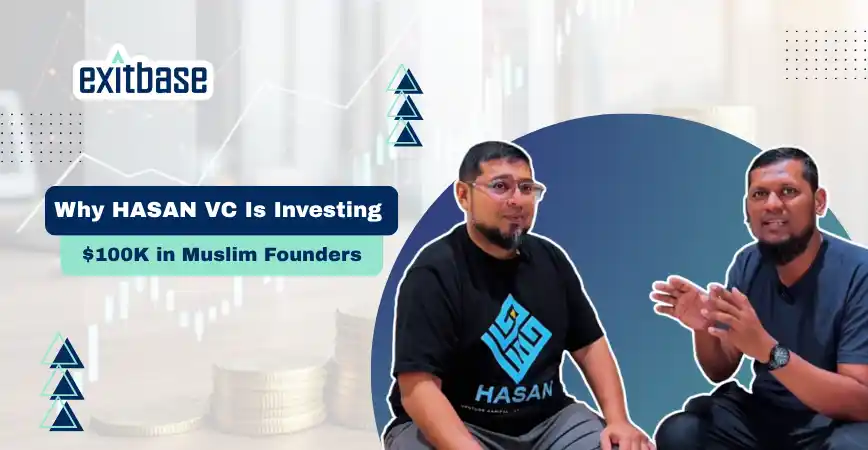
Why HASAN VC Is Investing $100K in Muslim Founders
I, Muhammad Nabeel, CEO of Exitbase, met with Umar Munshi from HASAN VC to understand how their venture capital model works, why they focus on Muslim Founders, and what they look for before investing in an early-stage startup.
HASAN VC focuses mainly on pre-seed and early-stage startups, particularly in emerging markets such as Indonesia, Malaysia, Pakistan, Bangladesh, and other parts of Southeast Asia. Their typical startup investment ranges from around $60,000 to $100,000, depending on the business, founder, and opportunity.
One of the most interesting parts of the conversation is their approach to building what Umar calls “Camel Startups.” Instead of blindly following the Silicon Valley model of chasing unicorn valuations at all costs, HASAN VC looks for startups that can survive difficult markets, generate revenue early, become sustainable, and grow with discipline.
Muhammad Nabeel Sits Down With Umar Munshi
I discuss their investment thesis, startup ticket sizes, emerging markets, halal investment, and the challenges faced by early-stage founders with Umar Munshi.
HASAN VC focuses on pre-seed emerging markets and typically invests $60,000 to $100,000 in startups. The fund also works with angel investors who invest different amounts depending on their appetite and alignment.
The conversation covers:
- How HASAN VC selects startups for investment
- What makes a founder investable at the pre-seed stage
- Why Muslim founders often struggle to find halal investment
- How much HASAN VC typically invests in each startup
- The role of their accelerator program
- How founders can position themselves for future VC rounds
- Why governance, compliance, and proper business structure matter from day one
- How HASAN VC connects promising startups with larger investors and VC funds
- Why investors should only invest money they can afford to lose
- The risks involved in venture capital investing
What Is HASAN VC?
HASAN VC is a venture capital fund investing in pre-seed and early-stage startups. Umar explains that they look for strong founders who want to solve real problems. HASAN VC currently has 37 startups in its portfolio and aims to increase that number.
The fund describes its approach as halal, with halal funding and a focus on Muslim investors and founders. Umar also explains that HASAN VC evolved from an angel group called Halal Super Angels, which had been investing as a group for around six or seven years.
Umar Munshi’s Background
Umar Munshi explains that he has been an entrepreneur since the age of 18 and has worked on several businesses.
For around 15 years, his focus has been on FinTech and Islamic finance. In 2012 and 2013, he was involved in helping Muslims invest in halal opportunities by matching projects and businesses with the community through a platform.
He explains that crowdfunding, crowdlending, and crowd investments were still relatively new in that part of the world at the time.
How HASAN VC Fund Is Structured
HASAN VC has its fund in Labuan, Malaysia. Umar explains that they also have an angel group of around 100 people spread across different countries.
The top countries represented in the group include:
- Singapore
- Malaysia
- Saudi Arabia
- Canada
- Qatar
Around 70 members of the group have invested in the fund. HASAN VC also runs an accelerator program focused on pre-seed emerging markets.
HASAN VC Investor and Startup Ticket Size
For investors, HASAN VC operates as a private angel group. Investors can join through an application process if they are considered suitable and there is alignment with the fund.
Investors contribute different amounts, including $3,000 and $50,000. For startups, HASAN VC typically invests:
- Minimum investment: $60,000
- Typical investment: Around $100,000
- Higher investment: Possible depending on the opportunity
The focus is on investing early, when startups are still at the pre-seed stage.
How HASAN VC Works With Larger VCs
Umar explains that many larger VCs have capital but can find it difficult to invest in certain emerging markets. HASAN VC aims to provide deal flow to larger VCs by supporting startups at an earlier stage.
The fund has relationships across markets including Indonesia, Malaysia, and DC. Once startups develop and reach the next stage, HASAN VC can connect them with investors and larger VC funds.
For Exitbase, a business marketplace, this conversation also highlights how early-stage businesses can require structured support before approaching larger investors.
Why HASAN VC Focuses on Pre-Seed Emerging Markets
HASAN VC focuses on emerging markets, particularly Indonesia, Malaysia, Bangladesh, Pakistan, and parts of Southeast Asia. Umar explains that $60,000 or $100,000 can last a startup significantly longer in some of these markets compared with Silicon Valley.
The fund comes in very early and aims to help startups reach sustainability with a relatively small amount of capital. The approach is based on finding businesses that can operate with discipline rather than simply following the Silicon Valley unicorn model.
The Camel Startup Concept
Umar describes HASAN VC’s investment philosophy through the camel startup concept.
The camel represents an ability to survive difficult environments. Umar explains that the markets where they operate can be described as a “desert economy” in terms of funding.
The camel approach focuses on:
- Investing a relatively small amount
- Reaching sustainability
- Generating revenue early
- Developing product-market fit
- Becoming less dependent on continuous fundraising
- Raising larger funding rounds when the timing is appropriate
HASAN VC typically invests $60,000 to $100,000 and focuses mainly on businesses implementing existing technology rather than developing cutting-edge deep technology.
The Camel Approach and Business Sustainability
Umar explains that the camel approach is essentially bootstrapping with investment. The objective is to use a relatively small amount of capital to reach a sustainable position, typically within a year.
Once a startup reaches product-market fit and develops its own revenue and cash flow, it can decide when to raise its next round.
This allows the startup to become less dependent on continuously raising money. HASAN VC then aims to bring other investors into these companies as they grow.
Why Southeast Asia?
Umar explains that Southeast Asia has a large and growing population, including a significant Muslim population. He specifically discusses Indonesia and Malaysia and the opportunities created by their young populations and emerging economies.
Indonesia has around 300 million people, according to the discussion. Umar explains that even the top 10% of Indonesia represents around 30 million people. He also highlights the number of Muslim entrepreneurs emerging from these markets.
Muslim Founders and Halal Investment
One of the key themes of the conversation is access to halal investment for Muslim founders. Umar explains that many Muslim entrepreneurs in Southeast Asia do not have access to Muslim investors who understand venture capital.
HASAN VC aims to provide a halal alternative for founders looking for investment. He gives the example of Islamic-focused applications that have large numbers of users but struggle to find Muslim investors.
HASAN VC positions itself as one of the groups providing a halal investment option for these entrepreneurs.
HASAN VC Investment Model
HASAN VC typically takes equity of around 10%, plus or minus depending on the investment. The fund comes in at an early stage, when valuations can be below $1 million. The startups then use the investment to grow, generate revenue, and develop cash flow.
According to Umar, many startups can reach good revenues and cash flow within a year. At that point, they can continue growing with their own capital while HASAN VC brings additional investors to them.
The $3 Million Fund
HASAN VC has a $3 million fund and operates through four cycles. Every six months, the fund raises around $800,000, runs a cohort accelerator program, invests in that cohort, and repeats the process.
Umar explains that the fourth cycle is underway. The investors are primarily Muslim high-income and high-net-worth individuals. HASAN VC prefers to aggregate angel investors rather than accept very large individual investments.
Typical investment amounts include:
- $25,000
- $50,000
- $100,000
Investors can join the angel group through a suitability interview designed to make sure there is alignment of vision.
Portfolio and Exit Strategy
HASAN VC has a portfolio target of at least 40 startups. At the time of the conversation, the portfolio had 37 startups, with the expectation of reaching around 45.
Umar explains that the startups generally enter the portfolio at valuations below $1 million, often around $700,000 to $800,000. If startups grow and reach valuations of $10 million or $20 million, HASAN VC may sell part of its shares.
The fund may sell around 30% or half of its shares or holdings in these startups. The objective is to return capital to investors within the first three years, if things go well. He explains that this differs from a typical VC structure where investors may wait seven to ten years before receiving returns.
The Risk of Venture Capital Investment
Umar emphasizes that venture capital carries significant risk. He explains that investors can make a lot of money, but they can also lose their investment.
His message to investors is straightforward: only invest money you can afford to lose. The fund expects some startups to perform well and others not to succeed.
Umar explains that if things go well, investors could potentially see significant returns, but outcomes depend on exits, the market, and many other factors.
Governance, Compliance and Reporting
Another important part of the conversation is governance, compliance, reporting, and corporate structure. I highlight the importance of having proper registration, documentation, reporting, and structure when investing or building a company.
He agrees that governance and compliance are major issues for many early-stage founders in Southeast Asia. Some founders may not have shareholder agreements or proper corporate structures in place.
HASAN VC brings governance and compliance into its accelerator program and continues to ensure that these foundations are strengthened after investment. For founders, the discussion emphasizes the importance of establishing proper structures from the beginning.
Why Governance Matters From Day One
The conversation highlights that founders need to think beyond their product or idea. Proper documentation, reporting, corporate structure, and governance can become increasingly important as a startup grows and brings in more investors.
Founders should consider these matters from the beginning rather than waiting until they reach a later stage. The conversation also emphasizes being very honest in reporting and maintaining transparency with investors.
Ethical Investment and Muslim Founders
For HASAN VC, the investment model combines halal funding with a focus on Muslim founders, while emphasizing business fundamentals, governance, and ethical practices.
Umar adds another point about ethical behavior and investment. He explains that being religious does not automatically determine whether someone is ethical, and ethical behavior remains important in business.
Exitbase Perspective
The discussion provides an inside look at an early-stage VC model focused on emerging markets and Muslim founders. As a financial advisor, I also discuss the importance of proper business structure, reporting, governance, and understanding investment risks.
For businesses seeking structured funding, Exitbase also focuses on asset-backed financing businesses alongside its broader work with businesses and investors.
Key Takeaways From the Conversation
The conversation highlights several important points for founders and investors:
- HASAN VC focuses on pre-seed emerging markets
- Startup investments typically range from $60,000 to $100,000
- The fund currently has 37 startups
- HASAN VC aims to build a portfolio of around 40 to 45 startups
- The fund uses the camel startup concept
- Startups are expected to focus on sustainability and revenue
- HASAN VC aims to connect growing startups with larger investors
- Governance and compliance are important from day one
- Muslim founders can face challenges finding halal investment
- HASAN VC focuses on halal funding and Muslim investors
- Venture capital carries the risk of losing invested capital
- Investors should only invest money they can afford to lose
Final Thoughts
The conversation explores how early-stage venture capital can work in emerging markets and how HASAN VC approaches Muslim founders.
The discussion covers startup funding, halal investment, governance, sustainability, emerging markets, and the risks associated with venture capital.
For founders, one of the central themes is that funding is not only about having a great idea. Investors also look at the founder, market, execution, governance, sustainability, and long-term potential of the business.
Certified Business Consultant in Pakistan